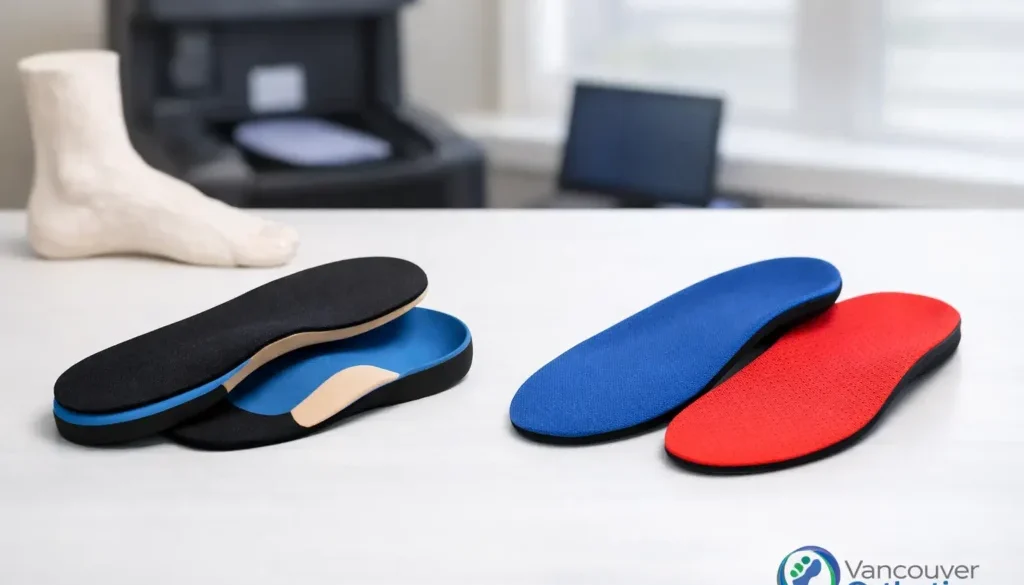
Custom Devices Versus Retail Insoles Compared
A $50 retail insole can make a work boot feel more comfortable by the end of a long shift. But if morning heel pain returns every day, your knees ache after a walk around the Seawall, or one shoe wears down faster than the other, comfort is only part of the question. Custom devices versus retail insoles is really a decision about whether you need general cushioning or an assessment-driven plan to address how your feet and lower limbs are functioning.
Retail insoles have a useful place. They are easy to try, readily available, and can provide short-term relief for people whose main issue is shoe comfort. Custom orthotic devices are different: they are prescribed after a practitioner evaluates symptoms, foot mechanics, movement, and contributing factors. Neither option is automatically right for every person. The better choice depends on the problem you are trying to solve.
What Retail Insoles Can and Cannot Do
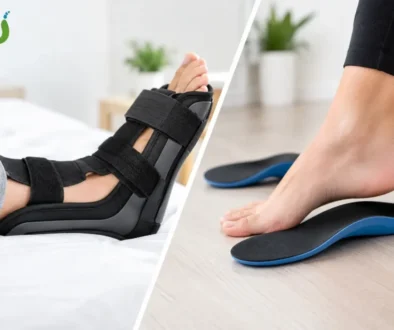
Retail insoles are pre-made inserts sold in standard sizes. Some are soft and cushioned; others have a firmer arch shape, heel cup, or metatarsal pad. They are designed for a broad range of feet, which is why they can be helpful when footwear feels thin, worn out, or poorly padded.
For a person who is standing for a few extra hours, beginning a walking routine, or looking to improve the feel of a casual shoe, an over-the-counter insole may be a reasonable first step. A supportive retail insert can also be useful as a temporary option while waiting for an appointment or as an extra insert for a less frequently worn pair of shoes.
The limitation is fit and function. A retail insole cannot account for the exact height and flexibility of your arch, how your heel moves during walking, whether one foot behaves differently from the other, or how your ankle, knee, hip, and low back respond to the way you load your feet. Even a well-made retail insert is still a general product.
That matters when symptoms are recurring. If an arch support presses in the wrong area, for example, it may feel uncomfortable or encourage you to avoid using it. If the device is too soft, it may provide cushioning without changing the loading pattern aggravating your plantar fascia, Achilles tendon, forefoot, or knees.
Custom Devices Versus Retail Insoles: The Clinical Difference
A custom orthotic device is not simply a more expensive insole. Its purpose is to support or accommodate your individual foot mechanics in a way that relates directly to your diagnosis and symptoms.
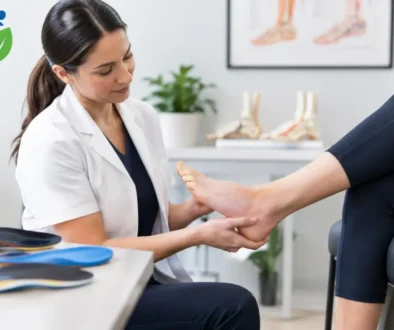
At Vancouver Orthotic Clinics by Dr. Michael Horowitz, custom orthotics are part of a structured five-step clinical process. The process begins with a practitioner-led assessment and diagnosis, then incorporates 3D foot scanning and a treatment plan designed around the person in front of the clinician – not an average foot shape on a store shelf.
The scan provides detailed information about foot contours, but the scan alone is not the diagnosis. The clinical value comes from combining it with an examination, health history, symptom pattern, footwear review, and an understanding of how you stand and move. A person with flat feet and plantar fasciitis may need a very different approach from someone with high arches and metatarsalgia, even if both are shopping for “arch support.”
Custom devices can be designed with different levels of firmness, contour, posting, cushioning, and targeted support. These details are selected to influence load and motion where appropriate, while still fitting the shoes you actually wear. For someone who rotates between runners, work shoes, and casual footwear, that practical fit is a meaningful part of whether an orthotic will be used consistently.
When a Retail Insole May Be Enough
A retail insole may be a sensible choice when discomfort is mild, recent, and clearly connected to a footwear issue. For example, a new pair of shoes with minimal cushioning may cause foot fatigue during a weekend trip, or an older shoe may no longer provide the comfort it once did.
It can also be appropriate if you have no persistent pain, no history of repeated lower-limb injuries, and no concerns about balance or changing gait. In these cases, think of a retail insole as a comfort accessory rather than treatment for a diagnosed condition.
If you try one, give it a fair test in the shoes you wear most often. It should sit flat, leave enough room for your foot, and feel supportive without creating new pressure points. Stop using it if it increases numbness, rubbing, sharp pain, or changes your walking in an uncomfortable way.
When a Custom Orthotic Assessment Makes More Sense
A clinical assessment is worth considering when pain keeps returning, affects your work or exercise, or has spread beyond the foot. Heel pain that is worst with the first steps in the morning, soreness along the Achilles tendon, repeated shin pain, forefoot burning, ankle discomfort, and knee or hip pain can all have biomechanical contributors.
This is particularly relevant for people who have already tried changing shoes, resting, stretching, or using store-bought inserts without lasting improvement. Replacing one generic insole with another can become expensive and frustrating when the underlying issue has not been identified.
Children and teens may also benefit from an assessment when foot pain interferes with activity, walking patterns appear to have changed, or symptoms persist despite appropriate shoes. Foot shape alone does not always mean treatment is necessary. The question is whether there is pain, reduced function, or a mechanical issue that warrants care.
The Trade-Offs: Cost, Convenience, and Precision
Retail insoles win on convenience. You can purchase one the same day, move it between shoes, and replace it easily. They cost less upfront, which makes them a practical option for simple comfort needs.
Custom orthotic devices require more time and a higher initial investment because they involve a clinical appointment, measurement, fabrication, fitting, and follow-up guidance. For many people with ongoing pain, that additional precision is the point. The goal is not to sell an insert; it is to make a recommendation based on what is contributing to the symptoms.
Extended health plans may cover custom orthotics when specific requirements are met, often including a prescription and supporting documentation. Coverage varies widely by plan, so it is wise to review your benefits before your appointment. A clinic team can explain common claim requirements and help you understand what documentation may be needed, but the insurer makes the final coverage decision.
There is also a durability trade-off. Retail insoles may compress or lose their shape relatively quickly, particularly under heavy daily use. Custom devices are made from materials selected for the intended use, although they still need periodic review as footwear, activity level, body weight, and symptoms change.
A Better Question Than “Which One Is Best?”
Instead of asking whether custom or retail is best, ask what is causing your discomfort and what outcome you need. If your feet are simply tired in one pair of shoes, a retail insole may be all that is needed. If you are avoiding walks, waking with heel pain, changing how you move, or repeatedly dealing with the same injury, a general insert may not be enough.
A practitioner assessment can clarify whether orthotics are appropriate at all, what type of support may help, and what other conservative measures should be part of your plan. Depending on the diagnosis, that may include guidance about footwear, activity modification, mobility work, or recovery support alongside an orthotic device.
For patients in Vancouver, Burnaby, Richmond, the North Shore, and Greater Victoria, choosing local clinical care also makes follow-up easier. Orthotics should be checked for fit, comfort, and response to treatment rather than treated as a one-time purchase.
If your pain has become part of your routine, it is reasonable to look beyond the insole aisle. A clear diagnosis and a device designed around your feet can give you a more practical path back to comfortable walking, working, and moving.