Workplace Ergonomics for Sore Feet at Work
The first few steps after a long shift can tell you a lot. If your heels sting when you stand up from your desk, your arches ache after a retail shift, or the balls of your feet burn by late afternoon, your work setup may be adding more strain than you realize. Workplace ergonomics for sore feet is not only about buying a softer mat or a more cushioned shoe. It is about reducing the repeated forces that keep irritating your feet throughout the day.
Foot pain at work is common among people who stand, walk, sit for long periods, or move between all three. A well-designed setup can ease unnecessary stress, but persistent symptoms deserve a clinical assessment, especially when they change how you walk, exercise, or get through your shift.
Why work can make your feet hurt
Feet are built to absorb load and adapt to changing surfaces. At work, however, they are often asked to do the same job for hours: standing on concrete, sitting with the feet unsupported, walking hard floors in worn-out footwear, or repeatedly pushing off while carrying items.
The problem is rarely just one factor. A retail employee may stand all day in supportive-looking shoes that are too narrow through the forefoot. An office worker may sit with their chair too high, leaving pressure concentrated at the back of the thighs and feet dangling. A healthcare worker may log thousands of steps on hard flooring while compensating for flat feet or reduced ankle motion.
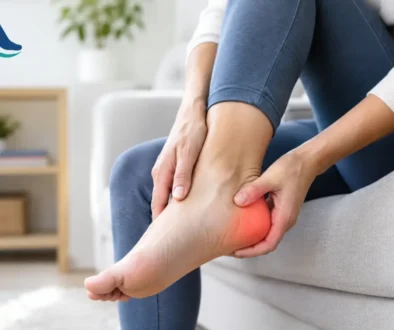
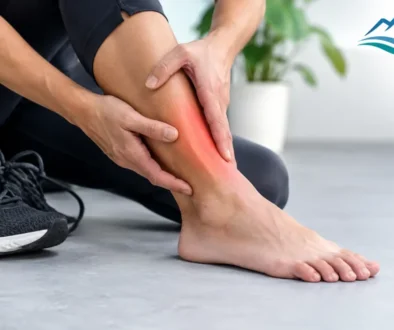
Those patterns can contribute to recognizable symptoms such as heel pain, arch fatigue, metatarsalgia, Achilles tendon discomfort, shin pain, and pain that travels upward to the knees, hips, or low back. Plantar fasciitis, for example, often causes sharp pain under the heel with the first steps after rest. It may settle as you move, then return after a full day on your feet.
Workplace ergonomics for sore feet starts with the task
Ergonomics should match how you actually work. There is no single “best” standing position or shoe for every job. The goal is to avoid being locked in one position long enough for tissue fatigue to build.
For standing jobs, shift your position regularly rather than holding yourself rigidly upright. If your role allows it, alternate one foot on a low footrest for short periods, then switch sides. This can reduce continuous pull through the calves and soles of the feet. Keep frequently used tools, scanners, supplies, or screens within easy reach so you are not repeatedly leaning forward or twisting from the ankle and knee.
A mat can help when you stand in one fixed area, such as at a service counter, workbench, or kitchen station. It is not a complete solution, though. A mat that is excessively soft can feel unstable, while one that is too thin may not change the load enough to matter. It works best alongside supportive footwear, task rotation, and brief movement breaks.
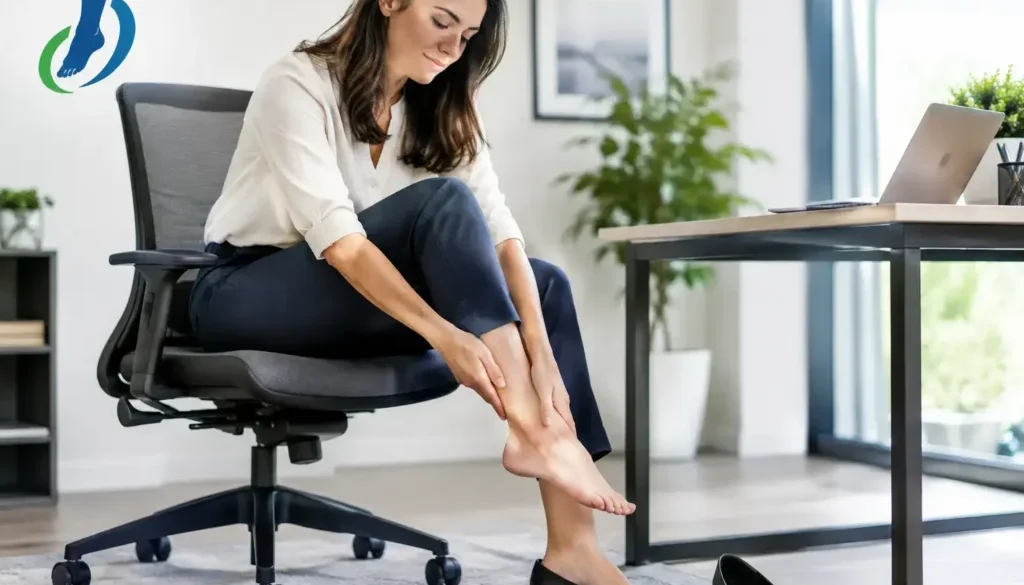
For desk-based work, check whether both feet can rest fully on the floor. If they cannot, adjust the chair height or use a stable footrest. Your hips should not be so low that your knees are forced high, and your feet should not be tucked under the chair for hours. Crossing your legs occasionally is not necessarily harmful, but relying on one uneven posture every day can add strain elsewhere in the lower body.
Make movement breaks specific and realistic
“Move more” is easy advice to ignore when the workday is busy. A better approach is to attach small changes to routines you already have. Stand and take 20 to 30 steps during a phone call. Change position after finishing a chart, email batch, customer transaction, or meeting. If you work on your feet, use a seated task when available instead of treating every activity as something that must be done standing.
During a break, gently move the ankles through their range of motion, raise and lower the heels a few times, and stretch the calves only to a comfortable tension. Tight calves can increase pull through the plantar fascia and Achilles tendon, but aggressive stretching into pain can make an irritated area feel worse. If your symptoms flare after activity, shorter and more frequent movement is often more useful than one long stretch at the end of the day.
Footwear should fit the job and your foot shape
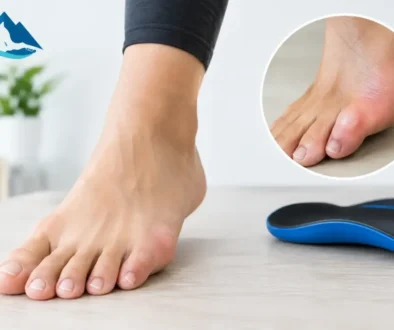
Work shoes do not need to be expensive to be useful, but they need to be appropriate for the demands of the shift. Start with fit. Your toes need room to spread without hitting the end of the shoe, and the heel should feel secure rather than slipping with each step. A cramped toe box can aggravate forefoot pressure and bunion discomfort, while a loose heel can increase friction and instability.
Look at the condition of your current shoes, not just their age. Midsole cushioning can compress long before the outside looks worn. Uneven wear on the outsole may also suggest that your foot rolls or loads unevenly. If you use a safety shoe, slip-resistant shoe, or uniform-required style, you may have fewer choices, making the fit and internal support even more important.
Over-the-counter insoles can provide temporary cushioning or arch support for some people. They are often reasonable for mild, occasional fatigue. But they are not interchangeable with a clinical orthotic plan when pain is recurring, one-sided, or connected to flat feet, high arches, ankle instability, or symptoms beyond the foot. More arch support is not automatically better. An insole that presses sharply into the arch or changes your gait can create a new problem.
Adjust the entire lower-body chain
Sore feet are sometimes the first place a workplace setup fails, but the issue may involve the whole lower limb. A monitor placed too low can lead to a forward-leaning seated posture. A chair that is too high can reduce stable foot contact. Reaching across a counter repeatedly can shift body weight onto one leg. Over time, small compensations can affect the ankles, knees, hips, and back.
Try to set your work surface at a height that lets your shoulders stay relaxed. When seated, keep your screen high enough that you are not continually bending your neck forward, and keep your keyboard and mouse close enough to avoid reaching. When standing, distribute weight through both feet and avoid consistently resting on the outside edge of one foot or locking your knees.
If your job involves lifting, pushing, or frequent stairs, footwear and foot function become even more relevant. Painful feet may cause you to shorten your stride or avoid loading one side. That protective pattern can be helpful briefly, but if it continues for weeks, it is worth identifying why it is happening.
When workplace changes are not enough
Ergonomic adjustments can lower daily strain, but they cannot diagnose the source of pain. Arrange an assessment if heel or arch pain keeps returning, morning pain is becoming more intense, swelling persists, numbness or tingling develops, or you are changing your walk to avoid discomfort. These signs do not always mean a serious issue, but they do mean a generic insole or a new mat may not be enough.
At Vancouver Orthotic Clinics by Dr. Michael Horowitz, a practitioner-led assessment considers symptoms, footwear, work demands, walking mechanics, and foot function. The clinic’s 5-step process includes evaluation and 3D foot scanning to help determine whether custom orthotics may reduce stress on painful structures and improve how the foot functions inside your work shoes. This can be particularly useful for people with recurring plantar fasciitis, flat-foot-related pain, metatarsalgia, Achilles tendon irritation, or lower-limb discomfort that has not settled with basic changes.
If you are considering orthotics through extended health benefits, ask your provider what documentation and practitioner requirements apply before your appointment. Coverage varies by plan, and clear information up front can make the claims process easier.
Your feet do not need a perfect workday to feel better. They need fewer hours spent in the same stressful pattern. Start with one practical change you can repeat every shift, then seek a clinical assessment when pain continues to limit your comfort or mobility.